Friday, March 16, 2007

Everglades Challenge report: Day 1


DAY 1: Fort De Soto to CP1
I hadn’t quite appreciated that there was a small craft advisory out that morning when at 0700 on March 3rd Chief yelled, “go, go, go!” But it was flat calm on our sheltered shore when I dragged my boat down the beach, pulled it over a small sandbar directly in front of the shore line, and immediately swamped the cockpit with the smallest of wash. Probably from SandyBottom as she’s hauling butt out of there! Back to the beach I go, raise the bow to take advantage of the boat’s pod seat, drain her out, and head back on out, Chief calling in my ear, “Go, Kiwibird!”

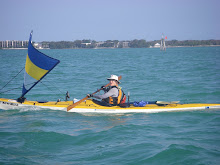
Tampa Bay very quickly got pretty lumpy, with a good 15-20knot NNE. I had my Pacific Action Sail up smartly, and as I zipped and zagged across the bay, the conditions made for an interesting passage.

Fairly quickly I could see the capsizes around me. I tried to help ManitouCruiser at one stage with a chap out of his solo kayak, but realized I’d probably be a quick casualty myself if I tried to turn up into the chop to aid him.

I hit my top speed for the day crossing Tampa Bay, reaching 9mph.

The brightly coloured sails of SandyBottom and Manitou Cruiser were a good reference point in the distance as the chaos of Tampa Bay receded into the calm of the lee at Sister Keys. I caught up with SandyBottom here, but she slowly pulled away as we headed down Sarasota Bay, and with that, the wind also picked up again for a good reaching breeze. Team RAF finally passed me, smoking along, each other crew member perched out on the akas for balance – felt so proud of the boys as they whooped past. “Mum’s up ahead!” I yelled.

Etchemin and Porky pulled up in a speed boat, and I was to see them a couple of times that day, taking photos and temptingly offering beers as they wished us well.

At Roberts Bay I caught up with KneadingWater and joined him on the beach of a small wooded spoil island for a quick break.

For a first-timer, both EC-wise and this part of Florida, it was interesting seeing all the development crammed along the sides of the channel - what folks do for a sea view.

Towards Venice Inlet, I’d caught up with SandyBottom, and passing Snake Island, CrazyRussian had pulled up, rummaging through some gear. Snake Island had been one of my possible campsites. A couple of tents were already pitched there, but they weren’t WaterTribers.

Through the Venice Canal ‘ditch’, I paddled with SandyBottom, SavannahDan and Paddlemaker in their Pygmy triple, with Oaracle sailing along beside us. Into Lemon Bay, and I left the paddlers behind me.

Nearing dusk, just before the Manasota Key bridge, I pulled over to the left for a change of GPS batteries and another layer of warmer clothing. Lo and behold, head poking through the scrub, Etchiman appeared, asking if everything was okay and that he’d seen me pull in.

And from there I didn’t see anyone else until arriving at CP1. It was pretty dark heading up those last miles to Gasparilla, and also started to rain. At one stage I missed the channel and ran aground – it took a few minutes to get off against the wind wanting to blow me back again. A little while later, I’d missed the channel again and with the raised sandbar between me and the correct channel, I hopped out of the boat and dragged it the 15 to 20 feet over to the correct side.

I also met up with a barge coming up towards me through The Cutoff and hopped over pretty smartly to not incur any wrath.

It was pretty dark negotiating the final twists and turns into CP1 – I’d spent some time pouring over Google Earth and the route from Placida Channel, under the bridge and around to Grande Tours, and that memory served me well.

Arriving at CP1 at 21:10hrs after 14hrs and 10mins paddling, to cries of “go right, go right”, I was happy to camp for the night – I hadn’t quite planned to reach CP1 the first day, but the conditions had been perfect for it. I’d averaged 5.5mph, whereas I’d been anticipating 3.5-4mph. I felt absolutely stoked, and when phoning home to check in, said that if I was called home right now for some family emergency, I’d be a happy KiwiBird.

Half-an-hour later, KneadingWater and nearly an hour later, SandyBottom arrived. By then I’d had a hot shower and a hot meal and the tent was primed ready for a snooze.

Tuesday, March 13, 2007

EC gear reflections

I’m happy to admit that I’m a total gear head, with whatever sport I’m into. But with this year’s Everglades Challenge I really had an opportunity to test out everything I’d judiciously researched, bought or modified. Here’s what I thought of it all, and hopefully this may be useful to another first-timer, as I was.

The boat: has to be first on the list – not going to get far without it. Last year I ordered a Grahame Sisson
Arctic Raider from Grahame’s workshop in NZ – primarily for the EC – and a few months later it arrived in all its glowing (Vitamin C) yellow. I thrashed the boat during the EC but was in no way able to trash it. It flew. Unloaded it weighs 24kg (53lbs), and that made a huge difference. At one stage, running downwind with a Pacific Action Sail, I topped 20kph with 15-20 knot winds and seas of 2.5-3m – that day I averaged over 9kph (5.5mph) and covered nearly 300kms (175m) in the first three days. I bow to Grahame.

The boat’s ocean cockpit with pod seat was also useful. Believe it or not, I practically swamped the boat about three metres from the start line in about 10cms of water. Returning to shore, all I had to do was to lift the bow and all water flowed straight out. Folks asked about the comfort of the bare fiberglass pod seat at Key Largo, but I felt no discomfort whatsoever after 15 hour plus days of never getting out of the boat.

Another feature I recommend with the boat is its very simple rapid flow foot pump
– these can be easily added to any boat. I had a lot of waves wash or break over me and there was a lot of spray flying. Any seepage into the boat was instantly pumped away. The double foot diaphragm is velcroed to my foot rest, so all I have to do is to move my feet a few inches inwards and pump/push like mad. I still have to mentally coordinate pumping and paddling at the same time, though!

Pacific Action Sail (PAS): I was a Class 1 entry, which allows the use of a sail no larger than 1sqm. In my humble opinion, the NZ-designed and sold PAS is the only way to go. I appreciate that there’s a fair bit of controversy within WaterTribe on just how far these sails can point up into the wind, but I’ll stick to my guns that with dropping the leeward ‘mast’ as far down on the deck as possible and not interrupting your paddling stroke, I could make 55 degrees off the wind. If you don’t paddle there’s some fall off, but by keeping up a good forward stroke, some of that fall off can be compensated for. I paddled with it night and day when ever possible, but would certainly have dropped it at night had the seas got any bigger.

Greenland paddle: Hand-made for me by Bill Bremer of
Lumpy Paddles, I was one of only three people solely using a GP (and the other two were a tandem). I wouldn’t consider any other paddle for long distances, consistent headwinds and large following seas. With the strong headwinds experienced on days 2 and 7, I just picked up the cadence and almost ‘chopped’ at the sea to move myself forward, and still made good times – and there’s almost no wind resistance involved. With the heavy following seas on days 1, 2 and 3, I used the length of the GP as an aka and ama, lengthening it out to windward and fluttering it across the surface to act as a brace.

Macpac Microlight Tent: Weighing in at only 1.8kgs with a single pole, this Kiwi-
made tent is the perfect get-her-up-and-down-quick shelter. I learned a few years ago not to bother rolling up and packing away the tent every time – takes up too many costly minutes. Instead, I jam it up into the bow, where not much else is shaped to fit. Then it only takes seconds to unpack and repack. This isn’t a stand-alone tent (those are heavier, so I don’t use them), so not as easy to raise on a chickee. One of the best features of this tent (and all Macpac tents) is that the inner and fly are co-joined (Multi-Pitch), so again, it only takes a few minutes to mount (and the inner doesn’t get wet when it’s raining). American and UK tent-designers really need to wake up to this age-old Kiwi innovation.

Hennessey Hammock: And, when I needed to sleep on a chickee, out came my hammock. Lashed diagonally across the chickees’ roof shelter poles, it was up in minutes. It was also cooler than the tent with its open mesh sides, and the view of the stars in the Everglades Wilderness Waterway breathtaking.

Sleeping system: For my sleeping mat I used REI’s
Lite-Core 1.5 self-inflating pad (which I normally inflate myself as I can’t wait that long). Sleeping bag was REI’s Nooksack UL +30 – was ultra-toasty in this. I have always used down, but am glad I made the switch to Primaloft Sport – there was a lot of heavy salt in the air! My bag liner was Macpac. Everything worked perfectly for me.

Stove: I deli
berately left my tried and trusty MSR WhisperLite Internationale at home as I didn’t want to bother with any priming and liquid fuel. So I brought along a MSR Windpro. Behaved flawlessly - packs small and burn time ultra-speedy. And I deliberately went with a stove where the burner is not on top of the bottle, as I didn’t want to risk a topple over of any hot water.

Dromedary bags: Thrilled I discovered these. I had three four-litre bomber bags full of Gookinaid going at any one time – two in the cockpit with me and another spare in my aft hatch. I also had another four-litre DromLite bag in the aft hatch with just water, for cooking and tent-bound night drinking. I was over watered between each leg by about six to eight litres, but I’d rather be safe than sorry. To drink from I used a
hydration tube and just swapped over to each bag as necessary. To keep the spray skirt closed, I’d slip the tube up under my skirt, top and PFD so it waved about in front of my lips. I made it a habit of sipping every ten minutes or so.

Urinating: My plans to use the
TravelMate failed dismally. I just couldn’t get high enough up from my pod seat to get a flow going. So I peed into my sponge (which was my only bit of gear to be trashed as soon as I hit the finish line!). I wore loose fitting Macpac hiking shorts with no underwear and even though there was invariably a bit of leakage, the sponge pretty much did the trick. On days 2 and 3 when it was just impossible to take a hand from the paddle and lift the sprayskirt, I peed in my shorts. The foot pump made rapid work of any pee. And I warned anyone near when landing at checkpoints that I may just pong a wee bit.

SunPaws: We women worry about wrinkled backs of hands and melanomas! I religiously wear Hydraulics’ SunPaws – they don’t interfere with my paddling and they don’t cause blisters. Another great Kiwi invention.

Lightweight kayaking jacket: I only took this off when we reached the Wilderness Waterway and temperatures
skyrocketed. Designed and made in NZ by Steve Gurney, the Cyber Jacket is made from lightweight nylon and folds down to nothing. I also like the fact that it’s colour-coded, so I don’t have to figure out the front from the back - silver on the front and yellow on the back. There’s a strip of mesh along the underside length of the sleeves, so any errant water drains straight out. When it was cold, I had just a layer of light weight Icebreaker merino underneath and was toasty.

Food: Chief always warns that we bring too much food. Well, he’s right. For breakfasts and lunches alone I’d packed 4.5kgs (10lbs) of bars and gu – that was seven separate ziplock bags for each day. One bag ended up lasting me about two days – so I could have at least halved the weight there. For dinners I packed seven freeze-dried dinners – I only had two left, so was happy there. I also packed seven bottles of Ensure – they were great – best bit of advice from Chief. If I didn’t have one before retiring to my tent for the night, I had one for breakfast. I had one left over in Flamingo and gave it to SandyBottom for our 0430 breakfast. For a full review of what food I took, click here.

Bumbag: You Yanks call these fanny packs – we Kiwis wouldn’t dare. I got this idea from Kneading Water’s rogue gallery photo, as I didn’t want a gear bag on my foredeck. Worn around my waist and above my spray skirt, I had everything I needed to hand without lifting my sprayskirt – energy bars and gu in a ziplock bag, painkillers (took 1000mg about every four hours), SPF 50 sunscreen, waterproof notebook (never used except to remember lockbox code and the time the Chokoloskee Rangers’ office closed and opened), a pencil with strips of duct tape wrapped around it for pressure points, small airhorn, liquid bandage and my trusty EPIRB. Thoroughly recommend this approach. (My bumbag was a 7-litre NZ
Macpac Module – mostly weatherproof with a heavy duty zip.)

PFD: In my Lotus PFD I had my VHF and that night's lightstick (never used) in the larger clip pocket, and in the smaller right-hand horizontal zip pocket, four small hand-held flares, a small waterproof torch, lip salve and digital recorder (latter as per Pelican's suggestion but never used as meant taking my hands off the paddle!). Attached to the back of the PFD was a Lotus 'back-pack' without its water bladder. Instead, I had a couple of larger hand-held smoke and glow flares, as well as an emergency hypothermia/survival kit (inside a small dry sack), which was packed as per Chief's recommendations.

Dry sacks: I only used Sea to Summit’s
lightweight dry sacks (the lighter Ultra-Sils were just that bit too much more $$$ and I figured the weight difference not enough to worry about). They were brilliant. Everything I had was packed in these dry sacks and labeled (dry gear, lunches, bath, cook, first aid, sleep, etc). Unpacking and packing from a campsite was quick and efficient.

Cockpit storage: I'd attached a
Northwater underdeck bag, which was excellent, even if I did pull the two left-hand stick pads off within the first two hours of the race - probably in all the excitement. This was an excellent piece of kit. Inside it I had my first aid kit (in a small dry bag), head torch, beanie (never used), water-proof tape for hotspots, spare batteries and my laminated trip plan. For next year's EC (hint. hint), I think I'll add a pair of side bags - I'd rather not have to access my aft hatch to get any additional gear out, though I'm hard pressed to think what additional gear I may need that wasn't in my bumbag and underdeck bag.

Footwear: My trusty Crocs were crabbed to a bungee cord on my rear deck, so I could grab them when necessary – I wore them around each camp, if not bare feet. While paddling I wore a pair of neoprene above the ankle booties with a Velcro strap so I could ‘feel’ my rudder bar more easily. Inside those, for wicking, I had a pair of thin Smartwool merino socks. I never felt as though my feet were too hot or damp, and there seems to be no fungus growth anywhere!

Clothing: I’ve mentioned my shorts…. For my top base layer I wore a
Skin200 Icebreaker Oasis Crewe. With Gurney’s Cyber jacket and the PFD on top of that, I was just right. When the temperatures really cooled or first thing in the early morning, I threw on Mysterioso’s M-Tech long-sleeved top – great piece of kit. In my sacrosanct dry bag I had a light pair of Macpac long-johns and for tops, wore first Icebreaker’s Skin200 Chakra Zip, then their Sport 320 Original Zip on top of that. If I was still cold or needed a quick night-time pee, I’d throw on Patagonia’s heavyweight Capilene top. When we hit the Wilderness Waterway I nearly died in any of the above. Thankfully, SandyBottom lent me a spare light-weight coolmax shirt, which I wore for the next four days (for some funny reason, she says she doesn’t want it back…).

We
t-weather gear: Thankfully, never used it as I kept toasty with my constant paddling. But if I did, I had Reed’s Chillcheater coverall cag deck. From the UK, I had this made to my neck and wrist measurements, as well as to fit my ocean cockpit. It’s not light, but it’s bomb-proof. I had it tucked away in a small bag in my cockpit.

VHF: I’ve no great experience in these handhelds to judge whether this is a ‘preferred’ or not, but I could receive the necessary weather forecasts, and that suited me just fine. I used
Standard Horizon’s HX370S. The only time SandyBottom and I really needed it was when trying to reach Kneading Water when he’d buggered off and left us – to no avail.

GPS: This is the first time I’ve used a GPS – Garmin’s
GPSMap 60CS – now discontinued and replaced by the 60CSx (don’t you hate that just after you’ve bought it!). I had no problems with it and quite enjoyed the new experience, having grown up only using charts. All my plotting was via Garmin’s BlueCharts – expensive but well worth it - and Garmin’s helpdesk is second to none.

GPS mount: Recommended by a discussion on the WaterTribe forum, I bought a
Ram mount specific for my GPS, even though it meant drilling four more holes in my beautiful hull. I had a few problems figuring out how to attach the GPS to the mount - the mount has a hole in its bracket where the GPS screw mount is located, but I couldn't find a screw unit to fit that. So I made up a short bungee system which looped over the GPS' antennae - didn't budge, but did finally break the rubber loop across the top of the GPS, which didn't affect its performance in any way.

Cell-phone: I had a small Pelican waterproof case that protected my cell phone from salt-laden sea air (and also held my spare camera battery and 2GB memory card - neither was used). Trouble was, whenever I wanted to make a call, my fingers were wet and the air was salt-laden. In fact, SandyBottom constantly got me into trouble with her regular calls home as she used an
Aquapac flip phone case, clipped inside her cockpit, which meant her phone was always open ready to turn off and on at whim. I'll use this for next year's EC (hint, hint).

Charts: All waterproof. I bought a couple more charts than necessary and finally trim
med down to just four: Maptech’s #31 and #29; Waterproof Chart’s #39, and for the final leg across Florida Bay, Waterproof Chart’s #33E. I spent hours pouring over my paper charts, BlueCharts and Google Earth, working out routes and more possible routes, marking waypoints and possible campsites and bailouts spots. By the start of the race, I figured I’d almost memorized the entire route (and then, of course, I go off and do the Wilderness Waterway, which I had no original intention of doing). A trick I learned from KneadingWater, which I wished I’d figured pre-start but makes perfect sense, was to write on each chart at what date/time I passed a certain landmark – next year (hint, hint).

Chartcase: I had a full clip case, which I packed away after just a few days - it became too much of a hassle to open up, rearrange the chart and close down again each time. Instead, I just left each waterproof chart folded securely under my bungees.

Camera: M
y waterproof Pentax Optio W20 is superb - can't fault it. Trouble is, I never got to use it until around day 4 when the conditions had calmed down - I was just too busy keeping myself going. I kept it in a small velcroed pouch attached to my left-hand PDF strap, about chin height so nice and easy to reach. All-in-all, I can't believe how few photos and no movies I took. I'll just have to do next year's EC (hint, hint).

EPIRB: I used McMurdo’s
Pains Wessex Fastfind Plus with internal GPS receiver. It was gratefully a gift from one of my oldest NZ friends who said he’d like to see me again. Thankfully, I never had to use it. I had it clipped inside my bumbag around my waist for instant access and if I came to be separated from my boat.

And that’s about all the main gear I used. If you have any specific queries, please don’t hesitate to holler!

Monday, March 12, 2007

Back into the swing


All-in-all, this would have to be the best adventure of my life!

SandyBottom and DancesWithSandyBottom got me home safe and sound last night around midnight. It was a loooong drive home... and a very tiring day at work.

Thanks so much to everyone who followed my progress and gave me so much encouragement and inspiration - it meant a lot.

And all my thanks to FlysWithKiwiBird, who kept the blog updated and WaterTribe in touch with where I was at all times (where possible) - couldn't have done it without you! Which also means that I need to be a very very good bird for the next 12 months to try and get permission for next year's EC.

I did get growled at for not having some longer contact cell phone conversations, but I'm amazed at how focused one becomes when one's in race mode!

In the next few weeks I'll try and work to find the time to post blog entries on all the adventures we had, gear used and just what the true story is behind the above photo (courtesy of SnoreBringGator) of KneadingWater apologizing. In the meantime, there won't be too much paddling - the baby's room needs to be painted and prepared - it's week 32 tomorrow!


Saturday, March 10, 2007

EC Day 7... Safely Crossing the Finish Line!


KiwiBird arrived safely at the finish line in Key Largo yesterday at 15:08 tired, but with a smile on her face in thanks for the bucket of adult beverages waiting for her courtesy of KneadingWater.

There are so many stories to tell about this adventure (many that will be told by all Watertribers tonight after the awards ceremony/prize giving) that I'll let her fill you all in on the details when she returns on Sunday night.

Many thanks to everyone who has been following KiwiBird's adventure this last week and keeping positive vibes/prayers flowing her way. For official challenge results please see:
http://watertribe.com/DataAccess/Results.aspx .

For her first race at an expert level after less than two years of experience in a kayak (with a Greenland paddle no less!), the bird didn't do too badly.

PS. the photo above is from KiwiBird's cell phone.


Friday, March 9, 2007

EC Day 7..Three Miles From Finish Line!


DancesWithSandyBottom just called in from a sail boat outside of Key Largo and reported seeing KiwiBird three miles from the finish line! He said she has charted a straight course for the finish, which means she is heading in to the wind and should take about one to two hours to reach land.

Yesterday, KiwiBird called in at 15:30 to report she had reached Check Point 3 along with DancesWithSandyBottom, but had somehow lost KneadingWater along the way. Her Verizon cell phone wasn't receiving reception so she was calling via a borrowed phone, hence the minimal report.

After forceful prodding, she did admit that she saw "lots of alligators". And also reported that she "lost" her wallet two days ago at Check Point 2.

I thought this might of interest to those of you who are not familiar with the dangers of this race. It's the warning that is posted on the Watertribe site that all competitors have to read and sign before being admitted to the race.

No one ever said that KiwiBird was rational.


THIS IS A DANGEROUS EVENT
No Liability Or Responsibility

All people, companies, and agents associated in any way with any WaterTribe Challenge or event do not accept any liability or responsibility what so ever for your safety and well being.

Your safety and well being are your responsibility.

Consider the following:
The WaterTribe Challenges are long, grueling races that are extremely demanding, both physically and mentally. Entrants are encouraged to consult a physician to ensure that they are in good health and can withstand the rigors that participation entails. The physical demands of the race, combined with sleep deprivation, heat, cold, water, dehydration, and exhaustion, often cause participants to become disoriented. Amnesia, hallucinations, hypothermia, and other debilitating conditions are not uncommon. Such effects can impair judgment, a condition especially dangerous for the solo paddler or sailor.

All participants are required to comply with Coast Guard and local regulations regarding safety equipment and operation of their boat. Required Coast Guard equipment includes, but is not limited to, a PFD, signaling equipment, and lighting. Although the event rules require this compliance, the event organizers and associates will not take responsibility for your compliance. Your compliance is your responsibility.

A PFD is required by the Coast Guard and it is strongly urged that all participants wear them at all times. Weak swimmers or non-swimmers should not be in this race.

Water, even under normal conditions, involves certain inherent dangers. A person in a boat may be struck by overhead branches or man-made objects. A person may be struck by lightning. A boat may strike a stationary or floating objects causing injury. A boat may collide with another boat. A person in the water may be pulled under. He/she might be pinned against the boat or another object or under the sail. Boats and swimmers can be swept out to sea or into shoreline hazards. Even slow-moving water or small waves have tremendous force.

All participants are expected to be experts in their sport, their watercraft, and their equipment. Participants are expected to use watercraft that is seaworthy and suitable for the course. Participants are expected to be able to control their watercraft in any and all conditions. Participants are expected to become familiar with the course. All potential hazards of these races cannot be listed in this warning. If you are not an expert paddler and or sailor, do not enter this race. Even if you are a well prepared expert you may die.

Many participants will be tempted to travel at night. You should be aware that night travel adds to the potential hazards. Night travel also involves certain Coast Guard regulations on required lighting. Regard these regulations as minimums. As an expert you should be better prepared.
The effects of heat can be extremely debilitating and lead to injury or death. As an expert you are expected to know how to prevent and treat heat exhaustion and heat stroke.

The effects of cold water and weather can lead to hypothermia which can result in injury or death. As an expert you are expected to know how to prevent and treat hypothermia.
As an expert it is expected that you know how to protect yourself from the sun.

Lack of proper hydration (drinking fluids) and nutrition (eating) can exacerbate all dangerous aspects of the course and can result in injury or death. As an expert you are expected to know how to eat and drink properly before, during, and after the race.

Fresh water may not be available anywhere along the course except at the checkpoints. Animals will break into your boats and rip open plastic jugs to get at your water. After they take all your water, they will take your food. An expert would not let this happen.

Animal hazards are common. Within the last few years there have been several attacks on humans resulting in serious injury and/or death. These attacks have come from bears, cats, dogs, sharks, alligators, rattlesnakes, cottonmouths, coral snakes, sting rays, barracuda, spiders, bees, hornets, wasps, fire ants, ticks, and mosquitoes. Other dangerous or annoying critters, too numerous to mention, are also in abundance. As an expert you are expected to know how to counter these attacks and it is expected that you have an adequate first aid kit and that you know how to use it.

Mosquitoes are ever present year round in Florida and especially in the Everglades. November through March are the best times for less of a mosquito problem but they can still be dangerous. Mosquitoes can carry disease including, but not limited to West Nile Virus. And there have been documented cases of large animals dying from mosquito bites alone due to loss of blood. As an expert you are expected to be able to deal with mosquitoes.

There are poisonous plants in some parts of Everglades National Park that can harm or kill you. Poison from the Manchineel tree was used by the Calusa Indians against Ponce de Leon and his men. Eventually, Ponce de Leon was killed by an arrow covered with Manchineel sap. If you rest in the shade of these trees, you will receive droplets of burning sap. Rain running off the leaves is poisonous. If you burn the wood, the smoke is poison. If you eat the berries, they may be the last thing you eat. Rubbing the wood on your skin will poison you. As an expert you should be able to recognize the Manchineel tree and all other poisonous plants.

As an expert it is expected that you would not be in these races without any special medications required for allergic reactions or for any other reason.

As an expert it is expected that you will carry a GPS, a VHF, and a cell phone. Even experts are required to carry an EPIRB/PLB for WaterTribe Challenges. No expert would allow these items to fail due to water intrusion or lack of batteries.

As an expert it is expected that you will listen to current weather reports and that you know how to predict and deal with the weather around you. Remember that the race will not be put on hold for weather delays, but as an expert you should be able to determine if weather conditions are not safe for you and your craft. It is not necessary for anyone to travel during a small craft warning.

Weather of less severity than required for a small craft warning can still present dangerous conditions. As an expert it is expected that you can recognize dangerous weather conditions and take appropriate action.

Even though you consider yourself to be an expert you may be injured or die in this event. Rescue services are not provided by WaterTribe or anyone associated with this event. There are no chase boats. There are no life guards. There are no paramedics or doctors. You are on your own. If you get in trouble, you should call the Coast Guard or 911 or passing boats. Only after you have been rescued by them should you call Event Officials to inform them of your situation.

If you drop out of the Challenge at a check point, race officials will make an effort to pick you up and transport you back to your car as soon as possible, but there may be delays lasting several days before you can be picked up. You will not be transported to any place other than your car and/or the finish point. If you are not at the appointed place at the appointed time to get picked up you will be left behind.

If you drop out of the Challenge anywhere, you are on your own and no effort will be made to transport you . You will be on your own. If you do not notify race officials that you have dropped out, you could be liable for search and rescue costs.

This warning cannot list all hazards, dangers, or other safety considerations. Assume this is a very dangerous event that can cause your injury, death, or mental anguish. By entering this event, you are asserting that you are an expert and you take full responsibility for your own actions.

Let me try to explain this one more time. By entering any WaterTribe Challenge, you are agreeing that all the people, companies, and agents associated with the event owe you nothing nor do we owe you duty of care or any other duty. We promise you nothing. We do not and will not even try to make this event safe for anyone. This event is not safe for anyone. This is no joke. We won't even try to warn you about every known danger or hazardous condition, whether we know about it or not. If we do decide to warn you about something, that doesn't mean we will try to warn you about everything. If we do make an effort to make some aspect of the event safer, we may not correct other aspects, and we may even make matters worse! We and our agents may do things that are unwise and dangerous. Sorry, we're not responsible. We may give you bad advice. Don't listen to us. In short, ENTER AND PARTICIPATE IN THESE EVENTS AT YOUR OWN RISK. And have fun!

I, __________________________, have read, understand, and agree to all contained herein. Further I release ANY AND ALL PARTIES associated in any way with this event from liability or responsibility. I am an expert paddler and/or sailor, and I can take care of myself. My physical condition, mental acuity, and health is good and more than sufficient to meet any and all challenges before, during, and after this event. In the event of my death, incapacity, or disappearance, I direct my heirs, family, friends, attorneys, agents, and all other associates and representatives to hold ANY AND ALL PARTIES associated with this event harmless and free from liability or responsibility.

Signed: ________________________________
Date: ________________________________
Notary: ________________________________


Wednesday, March 7, 2007

EC Day 4...Change of Paddling Strategy


KiwiBird called in on Day 4 at 08:03, bright eyed and feathery-tailed, as she was in line at the Ranger's station for a permit to camp over the next two days in Everglades National Forest.

Previous plans had not called for entry into the Wilderness Waterway, but strong winds that propelled her south faster than expected and forming an ad hoc team with SandyBottom and KneadingWater convinced her to take a bit of a longer route. So the Three Musketeers will now be travelling together in a cell phone-free zone for the next two days, which means there will be no field reporting until most likely Friday.

Thanks to DancesWithSandyBottom for the following detailed routing for the Musketeers:

"The ad hoc team will travel the Wilderness Waterway down to Whitewater Bay and from there to CP3. From CP2 about 8:30am Tuesday, they will paddle ~25 miles to Plate Creek Chickee (or further on to Rigers River Chickee). Then on Wednesday they will paddle ~30 miles to Harney River Chickee (or farther on to Oyster Bay Chickee). Then on Thursday they will paddle ~30 to Flamingo. Perhaps cross the ~35 miles of Florida Bay on Thursday or Friday."

KiwiBird has reservations starting Friday at the Bay Cove Motel at the finish line (Flamingo), so I think she will be pushing to arrive on time. Thankfully, NOAA's weather forecast for Friday includes winds north to northeast near 10 knots, bay waters at a light chop and isolated showers. Not a bad way to end a 300-mile race!

(photo: courtesy of Kontiki's wife Heather of Foster Photo, from Wiggins Pass campsite)

Monday, March 5, 2007

EC Day 3...KiwiBird Hits 11.9 MPH !!!


KiwiBird called in at 05:30 this morning reporting a good night's rest and her intention to reach Check Point Two (CP2) by the end of the day. The photo above shows KiwiBird with SandyBottom last night on the beach at Wiggins Pass, courtesy of Kontiki's wife Heather of Foster Photo. I bet you never saw a KiwiBird with yellow feathers before!

It was feast or famine today with a maximum speed of 11.9 MPH (a personal record), moving average of 5.5MPH and overall average of 4.3MPH. While the personal record was thrilling, she was down to only 1.5MPH atpaddling against the tide up the entrance to Chokoloskee on her way to CP2. She reached CP2 at 19:15 this evening, charting a total of 174 miles since the start of the race.

It was another spirited ride for KiwiBird as she endured constant sea spray in her face, while sailing over 6-8 feet swells powered by 15 knot north-northeasterly winds. At one point a large wave broke over the back of her Arctic Raider kayak and almost capsized her. She said that if she had capsized at any point during the high winds she didn't think she could have gotten back in the boat and would have had to call for a rescue.

Her wildlife encounters included more dolphins and pelicans, plus a few white egrets and blue herons. It seems the gators have gotten the word that KiwiBirds are not very tasty, as nary a one has been sighted as of yet.

Tomorrow KiwiBird will head south to Check Point Three. Chief announced the winning team (a class 4) hitting the finish line today after 2 days, 8 hours and 56 minutes. Props to Roo and Tinker for an awesome run!!!

KiwiBird Quote of the Day: "When that wave broke over me, it was a wee bit scary!"

EC Day 2...Dolphins, Pelicans & Sharks..... Oh My!


KiwiBird called in at 06:30 on day two of the Everglades Challenge from Check Point One. After a good night's sleep she was anxious to get on the water, allowing for a whole 10 second phone call to say she was off and heading south.

Day Two's stats include completion of 51.8 miles in 12 hours with a maximum speed of 8 MPH, a moving average of 4.3MPH and an overall average of 3.9 MPH.

KiwiBird reported that from CP1 to Sanibel Bridge was long and a bit arduous. She had to take her sail down prior to reaching the bridge and paddle hard against a stiff headwind. She traveled solo all day, only Sandybottom and Pelican in the distance after she'd passed them.

She also reported seeing lots of dolphins, pelicans and the odd shark, but no reports of alligators, yet. Some human wildlife in the form of Kontiki's wife Heather and friend Jason was encountered about four miles off shore after reaching Sanibel Bridge. Some photos were taken that she'd love to publish on her blog.

At 20:05 she called in and reported that she had reached Wiggins Pass about an hour prior, had set up camp on the beach and was looking forward to a hot meal. Sandybottom and NatureCalls arrived an hour or so later.

Day three's plan is to reach CP2 and then assess paddling strategy.

KiwiBird's Quote of the Day: "I've decided that I hate Clif Bars right now."

Saturday, March 3, 2007

EC Day 1...Oh, What a Day!!!

KiwiBird reached Check Point One this evening, at approximately 9:10PM. She reported an exhilarating day of sailing that started with a wave dumping water into her kayak 10 feet from the start line, requiring her to paddle back to the beach for a bailout.

The paddle across Tampa Bay was tempestuous, with several boats capsizing around her, one requiring a coast guard rescue. Swells were at 5-6 feet, with northerly winds at 15 knots. Her Kiwi-made Pacific Action Sail was up day and night, even through the rain, as she charted 65 miles in 13 hours and 49 minutes.

KiwiBird's highest speed was 9 miles per hour(mph) across Tampa Bay with a 4.8 mph average moving speed and 4.6 mph overall average.

She ran aground at one point and also found herself on the wrong side of the channel at another, forcing her to get out of her kayak and having to drag it across a sand bank.

KiwiBird was in good spirits, having taken a warm shower, jumped in to some dry clothes and waiting for the boiling water to work its magic on her meal in a bag. There should be more reports throughout the day tomorrow, as she was also notified of the new 8-hour check-in rule, necessitated by today's and the forecasted aggressive weather.

KiwiBird Quote of the Day:

"Wow, it's been just thrilling! If the Challenge was to end today, I'd be happy to go home!"

Thursday, March 1, 2007

Thelma & Louise's Excellent Adventure


Well, as of 0600 hours today the two female solo Watertribers have started their road trip to Tampa. They're hoping to hit the campsite by 1800 hours in order to join with their fellow Watertribe members for a bit of food, "grog" as the KiwiBird would say, and no doubt lots and lots of yarns.

It was just a bit of chaos yesterday evening as partners tried to provide support to the duo, one by providing sustenance and the other by staying up most of the night, ensuring that every item on the checklist was packed. This was in between many supportive phone calls from friends and family and double, triple and quadruple checks of all the gear.

Check out Sandybottom's Watertribe necklace, including the alligator tooth earned last year at the 1,500 mile Ultimate Florida Watertribe Challenge.

Last minute purchases for KiwiBird included a digital audio recorder, battery-operated cell phone charger and lamination of her tide charts and paddling strategy.

After a rather restless night of sleep, a full thermos of Earl Grey tea and a box of Thin Mint Girl Scout Cookies for the road, Sandybottom (aka Thelma) and KiwiBird (aka Louise) are ready to start their most excellent adventure!

Posted by: Flys with KiwiBird