Thursday, April 12, 2007

Age no barrier

One of the most enlightening and exciting features associated with this year’s Everglades Challenge, and of previous years, is that age is no barrier to having a right rip of a time.

Many sports still have the ‘oldies’ strutting their stuff, but sports associated with “messing about in boats” may well have a higher share. And I think this is one of my key loves about sea kayaking – it doesn’t matter how old I get, and how well I’ve thrashed my body over the years with the climbing, backpacking and ski mountaineering, I should still be able to keep paddling.

What first brought this to mind was a story in today’s NZ Herald that two Japanese yachties have been plucked to safety by a NZ ship near Guam, in what appears to be pretty rough conditions. The younger crew member of the stricken 11m yacht was 67. His mate was 72. Both were partially deaf. One suffers from high blood pressure and has reduced mobility due to the steel plates he has inserted in his back.

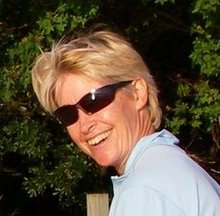
My dad (right) is 86 next week and is still sailing his 32ft Davidson around the NZ coastline for weeks on end.

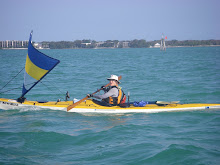
One particular crew comes to mind in this year’s EC - Tyro and PaddleCarver (photo above) – whose combined ages add up around 146.

And Audrey Sutherland, at 85 the Grandma Moses of paddling, is still doing her thing.

I’m not criticising the fact that the two Japanese, on their way across the Pacific to NZ, had to be rescued, but celebrating their attitude to life.

As my grandfather so rightly said: “You’re a long time dead.”

Tuesday, April 10, 2007

It's rough for the Kiwi Easter Bunny

Even though we appreciated the scrumptious Easter eggs the Easter Bunny left us as wee kids, who even signed the letters we wrote her with coloured paw pads, we were still Kiwis through and through with a general distaste for the hoppity pests.

So we good ol’ Kiwis sure know how to host the Great Alexandra Easter Bunny Hunt. (DISCLAIMER: Stop reading now if you’re of a sensitive mind.)

Alexandra’s a community in Otago, way down in the South Island. Last weekend was the 15th annual Easter Bunny Hunt, where teams of hunters are spread out over local farms and sheep stations, and have 24 hours to bag as many of the buggers as they can.

This year, 400 hunters shot more than 16,000 bunnies, a bit down on last year’s 22,000.

Just like the British colonial settlers brought gorse to NZ, thinking it a terrifically useful substitute for fencing and now another national pest, rabbits were introduced for hunting sport and to remind the Poms of home. Now, rabbits are among farmers' worst enemies in drought-prone Otago, where grass is scarce.

And I can’t help passing on the faintly quixotic e-mail address for the organizer: bunnyhunt@xtra.co.nz – true spirit!

Monday, April 9, 2007

Keep a lookout

One of my favourite radio shows as a kid was the BBC comedy, "I’m Sorry, I’ll Read That Again”. One of the best lines from one episode is from a chap who’s up the lookout.
Narrator: “Suddenly, there was a cry from the lookout.”
Lookout: “Look out!”
Capt'n: "What is it?
Lookout: "An iceberg."
Sound effects: major crunching of ice on wooden hull.
Lookout: “Don't worry. It's gone now.”

An acccident on NZ’s Waitemata Harbour last year left a salutary lesson to kayakers, and boaters. An 8m powerboat, travelling at 16 knots was about 60m away from Stuart Chrisp's yellow kayak when he waved his bright yellow paddle and shouted a warning.

Obviously, shouting at a boat with twin props and doing 16 knots means you’re not going to be heard. And blowing the obligatory whistle attached to your PFD is a waste of time in most circumstances. There’s really not a lot a kayaker can do when caught in such a predicament. Thus the onus is on the bigger and faster boats to do the right thing – keep a lookout and adjust their speed.

Skipper of the powerboat was a rear commodore of the Royal NZ Yacht Squadron (RNZYS), who should have known better. Last week he pleaded guilty in the Auckland District Court to failing to keep a proper lookout, and failing to consider the obligations of the vessel he was in charge of. Interestingly, he’s believed to be the first person in NZ to be prosecuted for colliding with a kayaker. I don’t know if that’s the case elsewhere in the world.

On the skipper’s side, as soon as he heard the "thump" of the kayak under the boat, he fished Chrisp out of the water. But that, quite rightly, wasn’t good enough for the Court.

Overall, it’s a good warning for boaties with fast and powerful boats; collision regulations clearly state that you must keep a proper and effective lookout and adjust your speed accordingly. Please. But it also means that we kayakers have got to be always keeping a wary eye out in areas with heavier boat traffic.

And Chrisp? Apart from the fact that he seriously thought he wasn’t going to see his wife and three kids ever again, he was whisked off to hospital with severe bruising and a locked back and, as any good Kiwi would, said he was in “bloody agony”.

Saturday, April 7, 2007

Cool kids

In a previous life, just a few years ago, I used to work for Sally Ride, America’s first woman in space. Sally’s San Diego-based company is Sally Ride Science, and she’s dedicated to supporting girls’ and boys’ interests in science, math and technology, but particularly in making a difference in girls' lives, and in society's perceptions of their roles in technical fields.

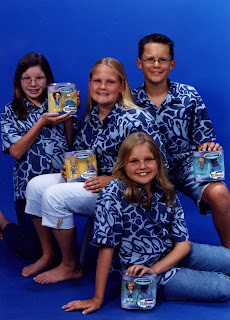
One of my responsibilities was to manage TOYchallenge, the coolest program for middle school girls and boys to design and build their very own toy or game. It was the best way we could introduce kids to the wonders of engineering and the design process. This is TOYchallenge’s fifth year, and when I took it over in its second year, I had the great honor and pleasure of meeting four very smart kids, Alyssa, Amy, Kaycee and Nicholas, who called themselves the Waveriders. Their prototype toy was “Boogie2Boogie”, and Janice, mum to Alyssa and Amy, was the team’s unstoppable coach.

The team figured that body boards, commonly known as Boogie Boards, were not well designed for kids, if at all. Older riders ride on the face of waves, farther out from the shore. Kids enjoy body boarding the breakers, the "white water," near the shore. So the team designed a board specifically for riding those breakers. Shaped almost like a boomerang, kids fit easily ‘into’ the board, adding to their safety. What’s also fun is that two boards can be strapped together via Velcro pads, so that friends can boogie together. And what’s really cool, especially for parents who often yell themselves hoarse trying to get their kids’ attention, is that each board has a red signal light on it. Parents just push the signal box they hold in their hands, and the red light flashes on the board.

Needless to say, the team co-won the 2004 National competition for best toy. Their prize was probably one of the best any child, or adult, could receive. Hasbro, founding sponsor of TOYchallenge, made each of them look-a-like dolls, right down to Amy’s glasses and freckles.

Since Boogie2Boogie’s debut in 2003, the team and its toy has gone on to international acclaim. They’ve been written about in books, on websites and on TV, including the BBC and CNN interviews with Miles O’Brien and Sally Ride. By Kids For Kids is even marketing Boogie2Boogie, hopefully soon to be hitting a shelf near you. And what is just amazing, is that the actual prototype boogie2boogies are currently on display at the California Museum for history, women & the arts.

A few months ago Alyssa and Kaycee were interviewed by Disney Movies, to highlight kids who are inventors. That snippet is just out now on the Internet, and I’d be very proud if you’d all take the time to quickly view the short segment. Click to access Disney's Movie Surfers website. Then click the right-hand ‘Spotlight Adventure’, “Meet the Robinsons”.

Aren’t kids cool?

Photo 1: The team displays their prototype for the very first time in 2003 at TOYchallenge 2004’s regionals, held at ASU, with Sally Ride. Photo 2: The Waveriders and their Hasbro look-a-like figures.

Friday, April 6, 2007

Where's Dana Chladek?


“I’m not a big thinker. I just paddle.” — Dana Chladek


Like many of you out there, our kayaking or whitewater wardrobes wouldn’t be complete without a few items of Fuzzy Rubber from Dana Chladek’s company, Rapidstyle. I for one love the stuff. And who can beat ‘sticky buns’ as a product name.

Dana’s a hugely talented woman. She emigrated from the former Czechoslovakia at age 5, and is a Dartmouth graduate. She’s a polyglot, and an awesome white-water kayaker, having taken up paddling at 13. She was a Bronze Medalist in the 1992 Barcelona Olympics and Silver Medalist in the 1996 Atlanta Olympics. She’s also a two time silver medalist in the World Championships and World Cup Champion. All that experience went into what we know as fuzzy rubber and metalite, under the umbrella of her company, Rapidstyle.

But Rapidstyle seems to have vanished off the face of the Internet. I first got a bit worried about nine months ago, when Dana hadn’t updated her site from taking pre-Christmas orders, for 2005. I checked it regularly – nothing had changed on the home page - but now the site’s gone altogether.

So, I went into hunting mode just that bit more, and spoke with Marty at The Jersey Paddler. He confirmed that Dana closed Rapidstyle down about a year ago, and is now concentrating on her children. Can’t fault that! Marty says they’ve got a wee bit of fuzzy rubber left in stock, but that’ll be it after that’s sold.

Thanks, Dana, for all you’ve done with Rapidstyle, and hopefully we’ll see you, and the kids, back on the water soon – and perhaps back in business too!

Wednesday, April 4, 2007

Go the black boats!

A bit bigger than our ol’ kayaks, but the opening fleet race of the Louis Vuitton Cup, which is the beginning of the countdown to the America’s Cup – started today off Valencia.

And this Kiwi is wrapped!

Those with long memories may remember NZ’s heartache when we lost the cup in 2003 to the Swiss boat, Alinghi, skippered by Kiwi Russell Coutts, who had been the winning skipper on the Kiwi boats that successfully defended the cup in 2000, and had wrested the Cup from America in 1995, in San Diego.

Folks back home were pretty upset that Coutts had bailed out on his own country – Dave Dobbyn’s hit song, Loyal, was almost the NZ national anthem – but the Black Magic crew was not prepared, and multiple gear failures played out to the ultimate failure, losing all the final races to the Swiss. How could anyone forget Black Magic’s cockpit filling up with water and being bailed out with a bucket! We wept.

So the eyes of New Zealand, and many other yachties around the world, are watching with bated breath as the countdown to the America’s Cup now plays out.

But if going by the great new artwork on Team NZ’s new black boats' keels – the ubiquitous Buzzy Bee and the NZ flag – we are good to go!

* Both photos by Chris Cameron.

Tuesday, April 3, 2007

Greenland rules

Jane, one of my great pals, has finally seen the light. She’s now the proud owner of her very own Greenland paddle, made especially for her by our mutual friend, Bill Bremer.

Bill also made my Greenland paddle, which I used in this year’s Everglades Challenge, and goes by the corporate nomenclature of Lumpy Paddles.

One of the best trips Jane and I had together, with our fellow paddler, Dee, was a five-day NC trip from Cedar Island in Pamlico Sound, punching up and out Ocracoke Inlet, down the coast, surfing back in New Drum Inlet, and then a circumnavigation of Cedar Island via Thorofare Bay. We had a great adventure paddling down the coast, surf landings and camping on the wonderful wild beaches of the North Core Banks.

Friday, March 30, 2007

Everglades Challenge fuel

So what did I eat during the WaterTribe Everglades Challenge. Some folks wanted to know (thanks, Craigcanoer).

I’m the type of person that if I don’t nibble regularly – about every four hours – I tend to fall over – and that’s sitting at my office desk. This was my biggest concern prior to the EC – how to keep my fire stoked so I could keep paddling non-stop for 12 to 16 hours. In the end, I had no problems – but I’d spent some time beforehand sorting out just what I would need to keep myself going.

With the research that I did, I figured I’d need 200-300 carbohydrate-calories per hour to keep up my endurance. A body’s system can only metabolize about 350 calories per hour, thus my target was to eat 30-60gms of carbs an hour – one can’t digest anything more than that.

So I planned accordingly.

In a small Sea to Summit dry bag I packed breakfast – five dried apricots and two muesli bars for each morning. These were eaten on the go as I packed up camp (mostly around 0400-0430) or perhaps even on the water. If I hadn’t needed to drink an Ensure the night before, I had that before casting off from the beach.

I packed in a large ziplock bag each day’s food, and stored all that in another Sea to Summit dry bag – it weighed a massive 10lbs/4.5kgs. Each day I’d pop one ziplock into my Macpac bumbag, clipped around my waist, sitting on top of my spray skirt – so instantly accessible. I figured that I needed to eat at least every hour, and that would mean at least 16 energy bars and Gu per bag, per day. I way over estimated, even though I felt I was eating very regularly – I suppose time does fly when you’re having fun. But I never felt hungry, so they did the trick. In the end, each day’s bag probably lasted me not quite two days.

Here’s what I had in each ziplock:
6 x Clif Bars
4 x Gu shots and 1 coffee Clif shot (didn’t like the latter; I don’t drink coffee)
2 x Moro bars (NZ - yum)
1 x Luna Bar
1 x Honey Bar Natural (yum)
3 x Natural Valley Oats ‘n Honey (bought bulk from Costco, half if not less the weight of a Clif bar, a bit dryish, but overall my favourite – I’ll take more of those next year)

Clif Bars were my main source of energy. I had a variety, ranging from Oatmeal Raisin Walnut to Chocolate Brownie. I tired of them pretty quickly (aah, day 2), but kept eating them as they caused no intestinal trouble and my bodily functions (I’m trying to be polite here) worked perfectly every (early) morning for the entire race.

The Gu shots were mainly consumed during the last few hours of the day when I needed an quick-and-easily digestible energy boost. Surprisingly, I didn’t use as many of them as I thought I would – I had a lot left over.

I also had a few bags of Target-branded beef jerky (my favourite taste-wise) and string cheese. Over a period of time, having some dairy product is really important for the body. But I surprised myself how little I really ate of both – most came home with me.

As soon as possible after hitting the beach at the end of the day, and certainly within 20 minutes, I drank 750mls/12ozs of Endurox R4. I had each day’s powder pre-packed in a small ziplock bag. I did try the Fruit Punch taste post-purchase and before I left for the EC, and hated it, but I wasn’t about to spend another $x on another container. (Perhaps REI could do pre-buy tastings…) By the end of a hard day, I didn’t really care – it did the job.

For most dinners I’d boil up a few cups of water and eat a Mountain House, two-person-serving of freeze-dried Stroganoff with Beef & Noodles – 620cals (I’m a creature of habit and can eat this particular flavour for days on end). I brought seven of the dinners along and ate all but one, though one night I could only finish half a bag. Before the race, I took off each dinner’s top tear-tab, took out the thing-a-me inside, pushed out the air and resealed the pouch by its own thread – every gram counts. And just before I hit my pit, I’d drink a bottle of Ensure (250cals). All the dinners and seven bottles of Ensure were stored in another Sea to Summit dry bag. I had one bottle of Ensure left over by race end (and gave that to SandyBottom for our last day’s breakfast).

I hydrated constantly all day. My bladder’s never been the best one off the shelf for expansion properties, but at least I wasn’t not urinating. The only time I drank pure water was at night in my tent. For the rest of the race I sipped fairly constantly – about every 10 minutes or so – on Gookinaid. I met Bill Gookin about five years ago when living in San Diego, and I’m a true convert to the benefits of his product. My MSR dromedaries were 4-litres, which meant 16 scoops of Gookinaid per water bag. I had each 4-litres pre-scooped into ziplock bags, and planned on two four-litre water bags per day. All those ziplocks were stored in their own Sea to Summit dry bag. In the end I only drank about two to three litres a day, so had lots of Gookinaid powder left over - and all that Gookinaid was pretty heavy.

All-in-all, I felt very comfortable with what I'd brought along, and had no health or hunger issues whatsoever. With the extra weight, which will be pared down for next year, I convinced myself that it all helped contribute to a longer waterline...

Wednesday, March 28, 2007

Messing about in boats #1

When I was 13 and in my first year of secondary school, I was Ratty in the play, Wind in the Willows. The book had been one of my favourites growing up. The best line of Ratty’s and the entire book, is: “There is nothing - absolutely nothing - half so much worth doing as simply messing about in boats.” What an adage for life. My dad (86 in April and still solo sailing a 32’ Davidson around the NZ coastline for weeks on end) reckons he would have been a wealthy man, if it hadn’t been for messing about in boats pretty much all of his life.

My own first boat, after the family sailing dinghies, was a Laser. I bought it from my Uncle Jim. It had a beautiful blue hull and the centerboard casing leaked. By the end of a day’s exhilarating sailing, the boat would be half full of water. But, wow, could I make some speed on a broad reach – and then it would throw me out and I’d have to swim for miles after it.

I then bought a windsurfer, which, much to my father’s bemusement, is still hanging from his garage roof back home in Whitianga on the Coromandel Peninsula.

During my third year at university (1982), I found a derelict looking 18-foot William Garden-designed yacht, looking rather forlorn on the hardstand down on the First Ave slipway in my home town of Tauranga. Reveries had a ‘For Sale’ sign hanging from it, and I was hooked. ‘Varsity was 100kms away, but I’d try to get home most weekends to work on the boat. I scraped everything down and repainted. Dad had a cabinetmaking business, with an upholstery shop, and his upholsterer made me new wool squabs for the two bunks. Dad even recovered the main hatch with teak decking, which I caulked and varnished. Reveries was my pride and joy.

After months of work, back into the water she went. There was no winch on this hardstand, so we pushed the cradle down into the water. Reveries had been out of the water for so long, the planks had opened up a good centimeter or so – you could practically see through from one side of the hull to the other. Of course, as soon as it hit the water, in poured Tauranga Harbour. Handbailing furiously, we dinghy-towed her around to the old Tauranga yacht club and stepped the mast. For two days and nights while moored out on the boat’s swing mooring, my brother and I took turns to bail while the other one slept.

Reveries had a small inboard engine – an old modified petrol Seagull outboard. It was the bane of my life. I would spend hours getting all the pauls lined up inside the casing to get her started, but would have to time my passage from the mooring to the jetty just right. Invariably the motor would konk out about three-quarters of the way, and judging the tide I’d just be able to drift in and down, kissing the jetty with perfect timing – usually to a round of applause from the old salts watching from the yacht club bar.

There’s nothing like the love affair with a first boat.

Tuesday, March 27, 2007

GPS mounts

I’ve had a few folks enquire as to exactly how did I mount my GPS to my Grahame Sisson Arctic Raider during the recent WaterTribe Everglades Challenge. And hang it, I can talk or write about gear ‘til the cows come home.

I’d been racking my brains as to how I was going to mount the GPS to where I could see it easily, was accessible enough to punch buttons, and didn’t interfere with either my Pacific Action Sail’s sheets or my Greenland paddle stroke - a bit lower than when using a Euro paddle. My kayak has an ocean cockpit, so I had a fair bit of room to maneuver with.

About four or so months before the EC started, someone on the WaterTribe discussion forum recommended Ram mounts. I researched which mount was specifically listed for my GPS – a discontinued Garmin GPSMap 60CS – and bought the two-piece Ram unit accordingly – a RAM-B-138-GA12U.

The unit came with two screws, and neither nut would fit either screw. I figured the unit really needed four screws, and bought a new stainless set from a local hardware store. Of course, this also meant drilling four more holes in my beautiful yellow topsides.

The next challenge I had to overcome was how to secure the GPS to the mount – there’s a ‘tunnel’ in the back of the mount for a screw to enter the GPS, but I couldn’t for the life of me find anything either Garmin-related or long enough to fit it (about 100mm). So I concocted some short bungee, which threaded through the ‘tunnel’ and flipped over the top of the antennae. The GPS didn’t budge the entire (wet) race, though the tension finally broke through the rubber loop of the GPS aerial, which thankfully didn’t interfere with the actual working of the GPS unit.

When I'm not using the boat, or the GPS, I loosen the wing screw on the side of the bottom mount, which releases the entire unit from the ball. The ball is left firmly attached (via the four screws) to the deck.

All-in-all, I was a happy bunny.