Tuesday, February 19, 2008

Hereeee's David

As FliesWithKiwiBird and the wee one will be driving madly around Florida during this year's Everglades Challenge, delivering SandyBottom's van to the finish line at Key Largo, I found myself without a blog-keeper for the six to seven days of the race.

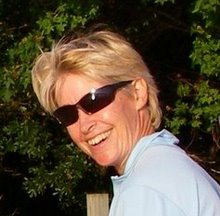
But all was not lost! I have a fabulous friend and work colleague, David (with a new WaterTribe name of Floatsome), who will be my right-hand mouse. David will also be receiving my check-in phone calls and SPOT signals - hopefully not the Alert 9-1-1 - so will have absolute power over letting you all know just where I am and what I had for breakfast. Well, let's hope it'll be a bit more exciting than that.

Hopefully we'll also be seeing David competing in 2009's Everglades Challenge - he more than likely will be buying from me the Mirage 19 I have safely tucked away for him. A total fitness guru, David has more marathons, triathlons and an Ironman under his belt than you can poke a stick at.

BTW, that's David on the right, Brian in the middle, and me on the left, half-way through the 2006 Tour de Cure.

Monday, February 18, 2008

Can you find me now?

The value of carrying a 406Mhz EPIRB has once again come to light off the coast of New Zealand. Ten French sailors rescued from a capsized racing trimaran 145km east of Dunedin are back on dry land. The 32m Groupama III was taking part in the Jules Verne Round the World Yacht Race when it overturned.

Now, a few years ago, being French, we Kiwis may well have left them, but even though memories linger, you have to move forward.

RCCNZ mission coordinator Keith Allen said the incident highlighted the value of people carrying this variety of EPIRB, which had greatly assisted in the rescue."Because the 406Mhz variety EPIRB is able to be detected by satellite within minutes, it gives rescuers an accurate position very quickly, which greatly speeds up any emergency response," he said.

"The fact that the beacon was also registered with up to date ownership details, meant that rescue agencies knew straight away who was in trouble and were able to make contact with them."

A 406Mhz PLB is compulsory for every competitor in the upcoming Everglades Challenge, so it's kind of nice to see it working in action. In fact, any kayaker doing any serious offshore kayaking should pack one away with them. I even take mine with me on road trips. Remember those women last year, in two separate occasions, who drove off the road and weren't found for a week or so...

Saturday, February 16, 2008

Rowing to Latitude

Have just finished reading Jill Fredston’s book, Rowing to Latitude: Journeys Along the Arctic’s Edge; and then dived straight into her later book, Snowstruck: In the Grip of Avalanches. Both are excellent reads, particularly the former for us water babies.

If you’re just into the multi-miled journeys that she and partner Doug Fesler row and paddle through, you’ll be gripped. And there’s also some poignant takes on life and life’s journeys tucked away here and there.

She has some excellent reflections on risk, but that’s a topic covered many times in like-blogs. What I particularly found of scaring interest is her take on the perception of what’s “truly wild.” Here they are, paddling in Norway: “Rowing the coast was like walking into a kitchen hungry and reaching for a perfect red apple, anticipating sweetness, only to find that the apple is made of wood. The experience frightened us to the marrow. It made us realize that… centuries of human habitation have nibbled away not only at the earth but our perception of what constitutes nature. When we do not miss what is absent because we have never known it to be there, we will have lost our baseline for recognizing what is truly wild. [my italics] In its domestication, nature will have become just another human fabrication.”

Tuesday, February 12, 2008

Hot, miserable, amazing


“The first thing I learned was that the man who has water on the mountain is king,” says hiking enthusiast Dana Law. “Water is absolutely the most important thing you’ll have in Southern California, because this really is the land without water. When I saw my first mountain spring I was totally shocked. It’s the most amazing, unusual thing I’d ever seen.”

My dear San Diego friend Dana, is soon to be speaking at La Jolla’s Ridford Library to talk about his experiences hiking the Pacific Crest Trail (PCT). He’s hiked 974 miles of the trail over the course of 22 separate journeys. I’m proud to say I’ve done a couple of t
hose journeys with him.

You can read more about his experiences on
his blog, and more about his upcoming talk from the San Diego Weekly Reader.

And you can read some of Dana and my earlier hiking tales here.

Dana’s wife says I’m the only other woman he’s allowed to share a tent with.

Monday, February 11, 2008

The NFCT calls...

Oh, to be young and a student again. One of my favourite paddling trails, the Northern Forest Canoe Trail, is looking for five keen, talented interns to work with them this summer. Pass on the good word if you know of anyone who may be interested.

The NFCT is an historic 740-mile water trail through New York, Vermont, Quebec, New Hampshire and Maine, and high on my one-day-to-do-list.

Three Stewardship Interns will help to maintain the Northern Forest Canoe Trail, coordinate volunteer work trips, and will have opportunities to mentor with professionals in the fields of natural resource management, ecotourism, recreation, outdoor education and environmental policy. Candidates must be self-sufficient and love being outdoors. Paddling experience strongly preferred.

The Program Intern will assist NFCT staff with the wide variety of activities that happen in the busy Waitsfield, Vermont office. The intern will primarily help coordinate stewardship programs, but will also assist with outreach, membership, Web site, publicity and communications with volunteers and paddlers.

The Youth Program Intern will help coordinate and lead NFCT’s new Northern Forest Explorers Youth Program in Maine. The intern will assist licensed guides with all aspects of trip preparation and leadership, and will conduct educational programming with students aged 10-14. Paddling experience strongly preferred.

The dates and details vary for each type of internship, but all will receive a $1200 stipend. More details and the applications are at posted on the Stewardship page of the NFCT Web site. Applications due February 29, 2008.

Saturday, February 9, 2008

Night sky

It's good to be alive.

After some serious negotiation I managed to transact a Friday's evening paddle, a night under the stars, and a Saturday morning on the water.

Hit the lake Friday at 1600 - not a breath of wind, not even a stir of a gasp - warm airs - almost a kiss on the face - one of those magic evenings. Saw the sun set over my right shoulder, birds nestling down for the night on the waters - not too fussed at my passing. Dark hit, and a new moon ahigh, reflected on the absolute still waters beside me.

There's something about paddling at night - complete self dependence, touched with a slight tingle of... fear, perhaps. I certainly jumped when the boat hit floating debris. But such a clear night, I could almost speak to every star.

Slept like a log on my new Exped down mat - holy grail - probably would have been pretty chilled without it, fully dressed in Icebreaker inside my bag. Didn't bother with a hot breakfast - snacked on some apricots and a Clif Bar as I packed, and on the water by 0700.

A touch of pink on the water, just for a few seconds; and not a whisper of breeze nor another boat or even a gasp for a few hours. And returning home, a useful breeze - nothing fancy, but enough to raise the sail - to help get me home.

Made me appreciate, if you don't paddle, you don't get there, but if you do paddle, you do, and you feel.

Ah, it's good to be alive.

Friday, February 8, 2008

New gear #2

Another new bit of gear, and ethos, I’m packing with me for this year’s Everglades Challenge, is a personal waste system, and a pledge to pack it all out.

I’ve recently written an article, soon to be published by Sea Kayaker magazine, reviewing five or six poop systems that we kayakers can use while paddling out in the wild. And I must admit, testing the systems and writing the article has changed my own views on my personal responsibilities to lessening my impact in as many ways as possible.

So I’ll be including with all my EC gear, six or seven (I’m a pretty regular kind of gal) Phillips Environmental WAG Bag waste kits. (WAG stands for Waste Alleviation and Gelling). What I really like about these kits is that they're completely biodegradable once deposited anywhere destined for landfill.

I asked my fellow EC paddlers on the Watertribe discussion forum what their thoughts were on this sensitive subject, and a few folks wrote back with some interesting thoughts. One main point being that you don’t have to buy expensive systems to follow this ethos – newspaper and a ziplock or ordinary plastic bag will do the trick.

But something that did disappoint me a wee bit is that folks argued that if it’s allowed by “the authorities” to poop above high tide etc, then that’s okay to do so. My point here is that if we all keep pooping in the wild, even where we’re allowed to, it’s all one day going to come back and bite us in the… rear end.


Thursday, February 7, 2008

An ode to the horseshoe crab

FliesWithKiwiBird and I first visited North Carolina for a fortnight’s summer holiday in 2004. (Little did we know that just over a year later we would be moving there, lock, stock and kayak from San Diego and living, it seems, somewhat permanently.) On that holiday, we made a visit to the state’s Outer Banks. From Hatteras Island we hopped aboard a small water taxi and shot across Pamlico Sound. Dropped off on the inside shore of Shackelford Island, we were left free to wander for a good few hours.

I remember being astounded by the warmth of the Atlantic Ocean – in which I just had to skinny dip – the magnificent unspoiled dunes, wild horses, and the shells we gathered as we wandered.

And then a treasure find of all treasures. On the way back to our pick-up point, I found a large, prehistoric-looking, brown, curve-backed shell creature with a long pointy tail. It was obviously just the shell, as no body resided beneath. I’d never seen anything like it in all my life! Clutching it to me, insistent that it come back with us on the plane, I asked our water taxi captain what on earth it was. “‘Orseshoe crab,” he smiled. “As old as the ‘ills, and ‘undreds of ‘em ‘round ‘ere. Though that’s a ‘tic’ly big ‘un.” And back it did go home with me.

Now that I’ve kayaked the shallow warm waters of Pamlico Sound where they congregate like mussels on a rock, and wandered Shackelford’s beach many a time, I’ve found lots of dead horseshoe crab shells, of all sizes (but none as big as my first treasure). And I’ve sometimes found them alive, in the water’s shallows, trying to upright themselves in the surf – always glad to tip them over with my toes and help them on their way again.

So a week or so ago, I was all ears when National Geographic News reported that a newfound fossil species of horseshoe crab (left photo above) dates back at least 455 million years - roughly a hundred million years earlier than horseshoe crabs were previously thought to exist.

The ancient animal is remarkably similar to modern horseshoe crabs (right), according to the team that found the fossils in Manitoba, Canada.

Photograph courtesy G. Young, the Manitoba Museum (left); D. Rudkin, Royal Ontario Museum (right)

Wednesday, February 6, 2008

Messin' about

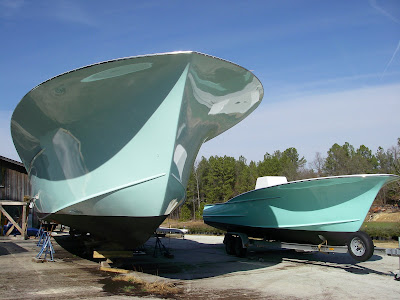
There's something about watching a boat being built - no matter what size - from keelson to tuck (something my dad used to say) - from actual reality, seeing something grow, to even watching the efforts of others online.

Keeping an eye on SOS and DancesWithSandyBottom building their Core Sound 20 is a real delight. But over the last few years, I've also been watching another boat. Every time I've driven to or returned from the put in at Ebeneezer at Lake Jordan, I've kept an eye out on a cruising launch being built out in someone's yard. Being a yachtie myself, I can still admire the sleek lines and very racey bow flare. And I had to smile, when the grandchild appeared beside it one day.

So this last weekend, I actually stopped and took some photos.

Tuesday, February 5, 2008

Water weekend

A beautiful weekend here, with temperatures near C20 (mid 60sF), thus what could be better than both Saturday and Sunday paddling out on the lake. It all felt as though it was coming together nicely for the upcoming Everglades Challenge, though I'll start loading the boat up/down with weight for the rest of this month's paddling.

I don't remember seeing so many normally coastal birds this time of the year, so far inland. There were definitely more shags (cormorants) than normal; and hundreds of what I took to be Forster's Tern, with its nearly all-white plumage and forked tail. In the absolute still of the lake, with not a breath of wind for mostly both days, their soft plummage littered the water.

I even bumped into SandyBottom on Sunday, out in the middle of the lake. In her Kruger, she has a very distinctive silhouette. With all the training she's being doing, she's lost a fair bit of weight and is looking quite hot! I'll never forget first meeting her on the beach at Lake Jordan a few years ago, and marvelling at this canoe/kayak thing she was paddling, training for then the Everglades Challenge and Ultimate Florida Challenge. Either will FliesWithKiwiBird...

We talked about the logistics of getting bodies, boats and gear down to Tampa Bay at the end of the month, and then picking up the van and trailer for SOS and DancesWithSandyBottom's yet-to-be-finished Core Sound 20. This year, FliesWithKiwiBird is going to fly down, with the wee one, pick up the van and trailer and take a couple of days to drive everything down to the finish line at Key Largo. It will be quite a family affair!

And I finally got the SPOT satellite tracker sussed. But more on that tomorrow.